Bali markets are full of home decor. Most of it is not made in Bali.
Printed “batik” cushion covers, machine-loomed throws sold as handwoven, mass-produced carvings finished to look aged — the volume makes it hard to tell what actually carries the island's craft and what's shipped in by the container. If you want something that genuinely represents Bali, the difference is worth knowing before you buy, not after you've unpacked it at home.
Here is what's actually worth bringing back, and how to tell the real thing from the imitation.
Handwoven Endek — the textile to look for first
If you buy one textile in Bali, look for Endek. It's a traditional ikat-dyed cloth — the threads are dyed before weaving, so the pattern only fully forms once they're aligned on the loom. That process is why genuine Endek always has small irregularities: a slightly soft edge on a motif, minor variation from one piece to the next. Printed imitations are perfectly crisp and perfectly identical. That's the tell.
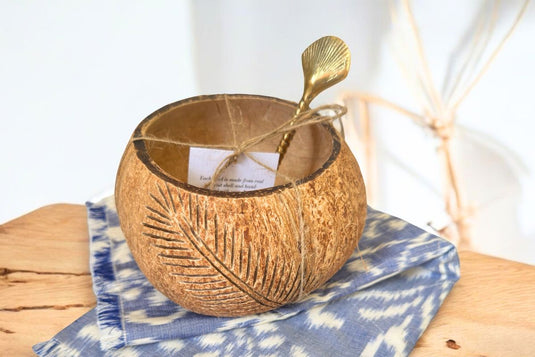
Endek has been part of Balinese ceremonial dress for generations, and it's just as much at home on a table. Our handwoven Endek tea towel and Endek table napkins bring that same weaving tradition into daily use — practical, genuinely handmade, and small enough to pack without a second thought. Each piece is subtly unique, which is normal and expected with hand-loomed cloth, not a flaw.

For something larger, the handwoven Ikat blanket is woven the same way at a bigger scale — a proper centerpiece gift rather than a small addition.
Coconut shell — nothing goes to waste
Coconut shell has a long place in Balinese craft. Nothing about the shell is treated as waste; it's carved into bowls, lanterns, and small household objects, each one slightly different because it's cut from a natural material, not molded. A carved coconut shell bowl or coconut lantern reads as intentional rather than decorative-for-the-sake-of-it, and it holds up to years of actual use.

Brass and teak — objects that improve with use
Balinese brasswork and teak carving both share one trait: they were never meant to sit on a shelf untouched. A brass cutlery set develops character the more it's used. A teak mini mortar is the same tool used daily in Balinese kitchens to grind fresh spice pastes — ours comes with a Sambal Matah recipe card, so it does something from day one rather than sitting in a drawer.

What to skip
Skip anything marked “genuine handmade” that's identical to twenty others on the same shelf. Skip printed batik sold as woven. Skip carvings that are suspiciously uniform in tone and finish — real wood and shell vary piece to piece. None of this means avoiding markets entirely; it means knowing what you're looking at.
The easier way to do this
You can spend an afternoon comparing stalls, or you can skip that entirely. Every piece in our Home & Living collection is sourced directly from Balinese artisans, priced transparently, and delivered same-day, gift-ready, to your villa or hotel — no bargaining, no guessing whether it's actually handmade.
Bring Bali home. We'll bring it to your door.